We design and implement your group's operational infrastructure.
The layer between your systems and an operation you can actually control.
The system is installed. Management is still explaining last month.
Without a common structure, comparing, controlling and scaling becomes harder every time.
Data, processes and responsibilities evolve at different speeds across units, brands, kitchens, points of sale and teams. Technology can connect the information, but it does not replace the operational judgement that has to organise it.
- Real food cost arrives when it can no longer be corrected.
- Sales leave the POS without the detail needed to explain recipes and consumption.
- The same product exists under different names, formats and prices.
- Purchasing, production and inventory rely on spreadsheets and informal knowledge.
Three ways to start.
We build the structure from the start so the operation is not born with data debt.
- Account and cost centre architecture
- Catalogue and master data
- Suppliers and formats
- Recipes and production
- Sales integration
- Training and go-live
We audit, clean up and sustain an account that is already running, but whose data or relationships may have degraded.
- Audit by cost centre
- Purchases with no traceable use
- Costs with no clear origin
- Duplicates
- Sales linked incorrectly
- Warehouses and analysis accounts
We review and correct a live account on a regular basis, so the data you decide with stays reliable.
- Review by cost centre
- Correction with approval and record
- Deviation tracking
- Regular review with your lead
Structure · Control · Scale
Three consecutive layers. The first builds a reliable base, the second turns that base into daily operation and the third turns it into a repeatable standard.
Operating model, catalogue, suppliers, recipes, cost centres, units and owners.
Explore StructurePlatform activation, team adoption, operational routine and data discipline.
Explore ControlMulti-unit rollout, central production, local autonomy and consolidated reporting.
Explore ScaleEvery phase delivers something that gets used.
We understand the operation and diagnose what is preventing control: catalogue, formats, recipes, sales output or responsibilities. From there we define and prioritise the steps according to what returns control soonest. Every phase ends with a concrete improvement that can be checked in the operation: a catalogue without duplicates, correct formats and costs, or a deviation measured by cost centre. It does not end with a presentation.
Sales come in. Operations turn them into control. Finance receives structured information.
Veraperse defines how data should travel between systems. tSpoonLab holds the operational layer; the POS provides the sale and the ERP receives the information finance needs.
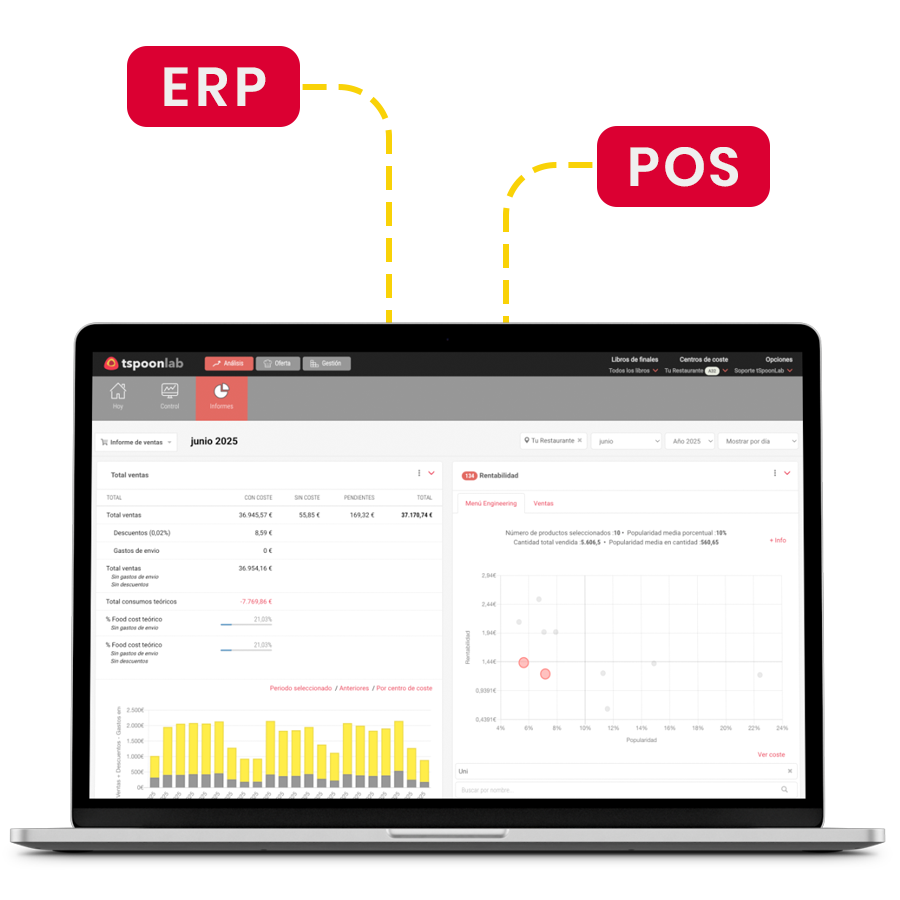
How the sale is structured and sent.
Purchasing, production, inventory, recipes, consumption and food cost.
How finance receives structured operational information.
Two complementary layers.
Veraperse designs, implements and sustains the structure. tSpoonLab is the specialised technology core where daily operation lives.
Diagnostic, operational architecture, data model, implementation, project direction and adoption.
Purchasing, production, inventory, recipe costing, transfers, traceability and cost control.
Experience built inside real operations.
Operations running on the tSpoonLab platform whose rollout or clean-up was led by the Veraperse team.








Technology used by operations such as the following. They are not direct Veraperse clients.







'%3e%3cg%20transform='translate(355.156%20428.106)'%3e%3cpath%20d='M507.443,410.124c-4.413,0-6.6-1.906-6.6-6.019v-5h1.906v5.209c0,2.852,1.531,4.033,4.7,4.033s4.7-1.182,4.7-4.033v-5.209h1.906v5C514.047,408.218,511.856,410.124,507.443,410.124Z'%20transform='translate(-481.98%20-399.106)'%20fill='%230E0F12'/%3e%3cpath%20d='M646.7,399.106h8.727c3.242,0,4.743.991,4.743,2.777a2.512,2.512,0,0,1-1.621,2.372c1.651.435,2.477,1.336,2.477,2.687,0,2-1.7,3-4.833,3H646.7Zm1.858,1.561v2.972h7.034c1.726,0,2.567-.435,2.567-1.456,0-1.066-.87-1.516-2.867-1.516Zm0,4.443v3.272h7.86c1.681,0,2.6-.585,2.6-1.636,0-1.156-1.156-1.636-3.017-1.636Z'%20transform='translate(-608.961%20-399.106)'%20fill='%230E0F12'/%3e%3cpath%20d='M794.862,407.422h-8.376l-1.576,2.522h-2.147l6.92-10.838h2.072l6.785,10.838h-2.132Zm-4.158-6.74-3.272,5.224h6.5Z'%20transform='translate(-727.411%20-399.106)'%20fill='%230E0F12'/%3e%3cpath%20d='M936.571,401.283v8.661h-1.906V399.106h1.966l10.358,8.736v-8.736h1.906v10.838h-2.071Z'%20transform='translate(-859.65%20-399.106)'%20fill='%230E0F12'/%3e%3cpath%20d='M1074.743,399.166l.03-.06h2.207l5.284,5.944,5.269-5.944h2.192l.03.06-6.544,7.355v3.422H1081.3v-3.422Z'%20transform='translate(-981.596%20-399.106)'%20fill='%230E0F12'/%3e%3cpath%20d='M366.455,400.682v3.633c0,2.852-1.531,4.033-4.7,4.033-3.055,0-4.61-1.022-4.784-4.033h-1.817c.075,3.966,2.264,5.809,6.6,5.809,4.413,0,6.6-1.906,6.6-6.019v-5h-1.906Z'%20transform='translate(-355.156%20-399.106)'%20fill='%230E0F12'/%3e%3c/g%3e%3c/g%3e%3c/g%3e%3cg%20transform='translate(28.474,15)'%20fill='%230E0F12'%3e%3cpath%20d='M-24.265-.85V-3.21h5.52v-.85h-5.52V-6.25h5.69V-7.1h-6.73V0h6.8V-.85Zm10.41.85h1.17l3.75-7.1H-10.1L-13-1.58a3.526,3.526,0,0,0-.26.63h-.02a3.378,3.378,0,0,0-.25-.63l-2.9-5.52H-17.6Zm7.12-.85V-3.21h5.52v-.85h-5.52V-6.25h5.69V-7.1h-6.73V0h6.8V-.85ZM.995,0h.95V-6.1h.03a3.064,3.064,0,0,0,.46.62L7.765,0h1.12V-7.1h-.95v5.99h-.02a2.029,2.029,0,0,0-.48-.66L2.265-7.1H.995Zm16.92-7.1h-7.78v.87h3.37V0h1.04V-6.23h3.37ZM22.305.25c2.39,0,3.6-.77,3.6-2.23,0-1.21-.77-1.79-2.58-1.97l-2.2-.22c-1.3-.13-1.74-.41-1.74-1.13,0-.78.85-1.2,2.42-1.2,1.72,0,2.61.55,3.02,1.61l1.04-.29c-.54-1.44-1.8-2.17-4.03-2.17-2.26,0-3.52.77-3.52,2.12,0,1.16.75,1.78,2.38,1.93l2.3.22c1.31.12,1.83.46,1.83,1.2,0,.88-.79,1.27-2.51,1.27-1.86,0-2.93-.59-3.34-1.82l-1.06.22C18.425-.53,19.825.25,22.305.25Z'%20transform='translate(25.305%207.35)'/%3e%3c/g%3e%3c/svg%3e)


Attribution is unambiguous: tSpoonLab platform references are not direct Veraperse clients.
Frequently asked questions
Before implementing a platform, let's design the operation it has to support.
We review units, systems, suppliers, data and responsibilities to define the real starting point.